
Pick’em vs Daily Fantasy Football
Daily fantasy in the original salary cap format, found on sites like Draftkings and FanDuel, is the pre-cursor to pick’em style daily fantasy format.
The idea is that if you can construct a lineup to full 9 positions after thorough research across several game environments then it would be light years easier to “just pick” a few “predictable” players that are sure to hit….
For daily fantasy players, this is often the premise behind pick’em style contest. It’s this very premise that sustains the irresistible danger behind “true” sports betting and parlays.
Mobile apps like PrizePicks and Underdog Fantasy have become quite popular and arguably much more pervasive with the masses in recent years compared to other DFS apps.
But is pick’em style fantasy actually worth your time? Logically, it feels like there would be an easy transfer of knowledge from salary cap DFS to “easy” picks, but there is always a bit of nuance to account for.
So here is a bit more on what pick’em contests are, how they differ from salary cap DFS, and if pick’ems are worth your time .
What Is Pick’em Style DFS?
Pick’em fantasy sports (or player props, over/under fantasy) is a format where you’re not building a lineup with a salary cap. Instead, you’re simply picking whether individual players will go over or under a projected statistical threshold.
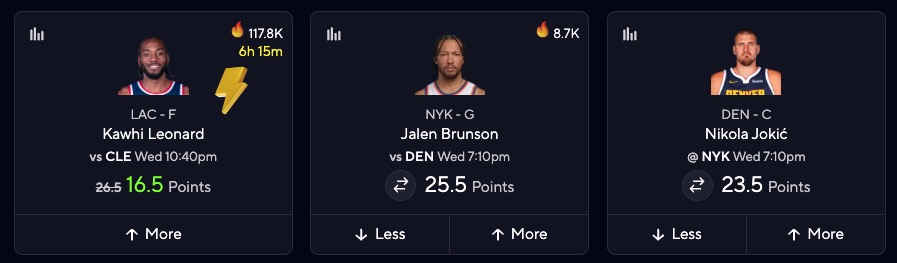
You select a few players per entry, choose over or under for each, and if all your picks hit, you win a multiplied payout on your stake.
The more picks you stack, the better— but every pick has to be correct.
Some platforms (like Underdog Fantasy) use a slightly different format called Best Ball or Draft, but the core pick’em style is the same.
Pick’em vs. DFS
| Traditional DFS (Salary Cap) | Pick’em DFS | |
|---|---|---|
| Format | Build a roster within a salary cap | Select over/under on player props |
| Competition | Compete against other players in a contest | Compete against the house (set lines) |
| Entry types | Cash games, 50/50s, GPPs | Flex entries (some hits needed), Power entries (all hits needed) |
| Lineup construction | Yes — player selection, stacking, salary optimization | No roster building; standalone picks |
| Number of decisions | 6–9 player slots to fill | 2–6 picks per entry |
| Variance control | Moderate — balanced through roster construction | High — especially on power (all-or-nothing) entries |
| Pricing model | Salary determines player access | Flat lines set by the platform |
| Skill ceiling | Very high | Moderate to high |
In traditional DFS, you can express skill in multiple dimensions simultaneously — player selection, salary efficiency, stacking, game theory, ownership leverage. The skill ceiling is very high because there are so many interacting variables to optimize for NFL daily fantasy.
In pick’em, your skill is essentially one thing: are you better than the line at predicting individual player outputs? That’s a real skill, but limited. You can’t leverage poor ownership. You can’t build a differentiated lineup. You can’t construct correlation.
Is Pick’em Skill-Based?
Player prop analysis. The lines on pick’em platforms aren’t always sharp. They’re often set close to Vegas prop lines, but not always perfectly. If you’ve been playing DFS, you already have the habit of evaluating player usage, target share, matchups, and game script — all of which directly translate to picking props accurately.
Line shopping and value identification. Not all platforms post identical lines. A receiver projected at 62.5 yards on one app might be 68.5 on another. Finding systematically softer lines is a real skill.
Game environment reads. Understanding game totals, implied team totals, pace of play, and weather conditions gives you a legitimate edge on individual player projections — just like in DFS.
Volume and variance management. Choosing between flex entries (which pay out even if you miss one pick) and power entries (all-or-nothing multipliers) is a bankroll and variance decision that rewards disciplined players.
Downsides of Pick’em Fantasy
The platform holds an edge. Most pick’em payouts are structured so the house has a margin — typically 15–25% depending on entry type and number of legs. In traditional DFS, the rake is typically 10–15% of the prize pool. Pick’em’s structural edge for the platform can be harder to overcome.
You can’t leverage ownership. One of the highest-EV plays in GPP DFS is correctly identifying a low-owned player who has a big game. In pick’em, there’s no ownership concept. Your correct read pays the same whether 1% or 80% of players made the same pick.
Line movement is limited. In traditional DFS, you can see salary changes and react. Pick’em lines may move, but you often don’t have the transparency into sharp money or market movement that savvy sports bettors use.
Variance is brutal on power entries. Going 4-for-5 on picks still pays $0 in a power entry. In DFS cash games, one good player can carry a lineup. The binary all-or-nothing nature of power pick’em requires a very different variance tolerance.

Entrepreneur | Web Publisher
Playing daily fantasy since 2018. Creating content on daily fantasy sports, business, and sports data analytics.