
What is Effective Field Goal Percentage?
Effective field goal percentage (eFG%) is a basketball efficiency metric that adjusts for the fact that three-point field goals are worth more than two-point field goals.
A made three counts as 1.5 field goals in the calculation, which gives a more accurate picture of shooting value than raw field goal percentage.
Essentially, this metric can help you understand of how Demar Derozan’s mid-range compares to Steph Curry’s 3-point shot.
When looking at game environment and an entire team’s succss from the field you can use eFG%.
Effective Field Goal Percentage Calculator (eFG%)
eFG% Formula
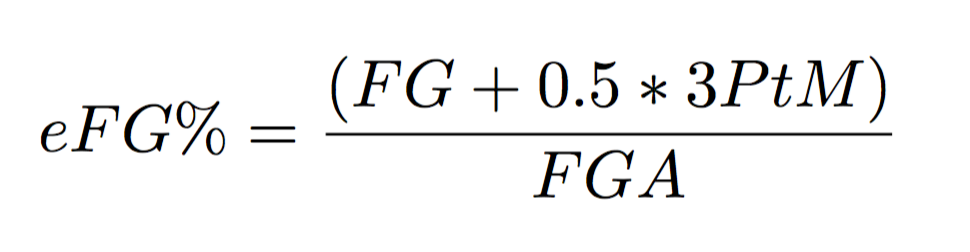
eFG% = (FGM + 0.5 × 3PM) / FGA
FGM — Field Goals Made
3PM — Three-Pointers Made
FGA — Field Goal Attempts
0.5 — the constant that weights made threes as 1.5 field goals
What is a Good Effective Field Goal Percentage?
| eFG% | Rating |
|---|---|
| 60%+ | Elite |
| 55–59% | Very good |
| 50–54% | Average |
| 45–49% | Below average |
| Under 45% | Poor |
NBA Effective Field Goal Percentage
2025-26 Regular Season
eFG% leaders tend to skew toward bigs and rim-runners who take high-percentage shots, alongside three-point specialists who shoot efficiently from distance. The common thread is shot selection — players who avoid mid-range attempts and operate at the rim or behind the arc tend to post the strongest eFG% numbers.
2024-25 regular season eFG% leaders (min. 20% usage, 20 min/game, 60 games played):
| Player | eFG% |
|---|---|
| Jalen Duren | 65.0% |
| Nikola Jokic | 61.8% |
| Chet Holmgren | 61.4% |
| Kon Knueppel | 60.1% |
| Zion Williamson | 60.0% |
2025 playoff eFG% leaders (min. 20% usage, 20 min/game, 3 playoff games):
| Player | eFG% |
|---|---|
| Ayo Dosunmu | 70.3% |
| Collin Murray-Boyles | 67.3% |
| Karl-Anthony Towns | 66.7% |
| Victor Wembanyama | 65.6% |
| RJ Barrett | 60.5% |
So far in the playoffs, Dosunmu is standing out in eFG% and TS% which says more about the Bulls’ front office and coaching staff than Dosunmu himself, but I digress.
eFG% vs True Shooting Percentage (TS%)
eFG% and TS% are related but measure things a bit differently.
If you’re using one without the other you’re missing part of the picture. While efficiency is implied in effective field goal percentage numbers , true shooting percentage can give you a much more accurate picture of how “efficient” a shooter is.
But I suppose everything is a bit debatable…..
| Stat | Adjusts for 3s? | Includes Free Throws? | Best For |
|---|---|---|---|
| eFG% | Yes | No | Shot quality and selection |
| TS% | Yes | Yes | Total scoring efficiency |
The gap between a player’s eFG% and TS% tells you something specific: how much of their efficiency comes from getting to the free throw line.
In the modern NBA, drawing fouls and getting free throws is a skillset in it’s own right and shouls be be factored into consideration when looking at specific matchups and players.
Insert Shai Gilgeous Alexander, personal opinions aside, when building lineups you have to consider how effective he is at getting to the line.

For a deeper look at true shooting percentage and how it applies to NBA cash game lineup construction, see the True Shooting Percentage Calculator →
eFG% in Daily Fantasy Basketball
eFG% is most useful in DFS as a shot quality filter — it tells you whether a player is getting good looks, independent of whether they’re drawing fouls.
Opportunity trumps talent and ability in daily fantasy, always. Being able to determine “opportunity” is valuable in certain circumstances.
Identifying efficient volume — Two players at similar salaries with similar recent scoring totals can look interchangeable in a DFS player pool. eFG% separates the ones scoring on quality attempts from the ones grinding out points on high volume and poor selection.
Spotting three-point dependent efficiency — A player with a strong eFG% but weak TS% is likely riding a hot three-point shooting stretch. That’s more volatile than a player posting similar eFG% through rim pressure and shot selection. I use both numbers together for this reason.
Pace and total context — In high-total games with fast pace, efficient scorers benefit more than volume scorers. eFG% helps confirm a player is converting the extra opportunities a fast game creates, not just taking more bad shots.
eFG% won’t replace matchup research or ownership analysis. But as a filter for narrowing a player pool in cash games, it’s a fast way to separate players who are scoring well from players who are just scoring a lot.

Entrepreneur | Web Publisher
Playing daily fantasy since 2018. Creating content on daily fantasy sports, business, and sports data analytics.